
What Highlander Teaches About Time, Power, and Consciousness

Yesterday afternoon I watched Highlander for the first time. I’ve made it through decades of pop culture without ever seeing it. Beneath the trench coats, sword fights, and music from Queen, the movie is philosophical. It’s about time, memory, power, loneliness, and what a human being might understand if they lived long enough to observe the entire arc of humanity.
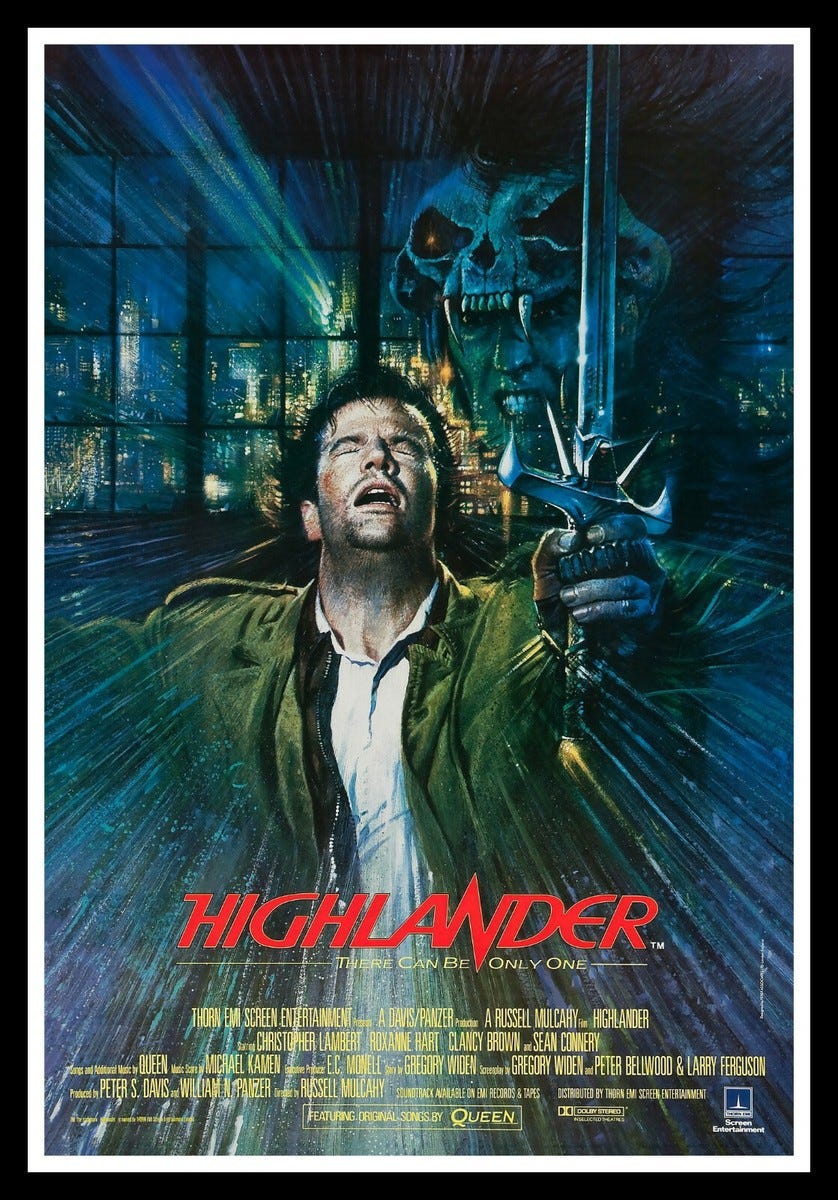
The story follows Connor MacLeod, a Scottish man born in the 1500s who discovers he is one of the immortals. He cannot die unless another immortal cuts off his head and over centuries he learns the rules of this strange existence from his mentor Juan Sánchez-Villa-Lobos Ramírez, including the most important rule of all: immortals eventually fight each other because there can be only one.
At first glance it sounds ridiculous, but the longer I thought about the story, the more it started to feel like a metaphor about consciousness and perspective. One of the implications of the film that stood out to me is that someone like MacLeod would know what actually happened throughout history. He wouldn’t need books or historians to interpret events. He would remember them firsthand.
He would know what wars were really about before they became patriotic myths. He would remember leaders before they became statues or legends and see how messy and human history really is before it gets polished into something cleaner for later generations.
If you observed humanity for centuries, something else would become obvious: people repeat themselves. The same power struggles appear again and again. The same fear cycles appear and generations believe they are experiencing something unprecedented, when in reality they are acting out patterns that have existed for hundreds or even thousands of years. The lesson of power: power reveals character. The movie makes it very clear that immortality itself isn’t good or evil. It simply magnifies who someone already is.
MacLeod becomes thoughtful and protective of life. The villain, The Kurgan, becomes more violent and cruel the longer he lives. The same power produces two completely different outcomes depending on the character of the person holding it. The story quietly suggests something important: power doesn’t change people, it reveals them.
MacLeod lives through centuries and countless identities. He adapts to different countries, different languages, and different cultures. Watching the world change forces him to change as well. The movie subtly points out that identity isn’t fixed. Human beings are capable of becoming many versions of themselves over the course of a lifetime. MacLeod simply experiences that process on a much larger scale.
One of the most emotional parts of the movie is the loneliness of immortality. MacLeod watches everyone he loves grow old and die. Entire eras pass and cultures shift. The people around him experience life in short bursts while he carries centuries of memory. Awareness has a cost. Imagine remembering people and places that the rest of the world has completely forgotten. The movie quietly suggests that death is what gives life its beauty. It’s a movie that illustrates as a metaphor for anyone who feels ahead of their time, misunderstood, or living outside the norm. Being different can bring insight and power but it often comes with loneliness.
Someone who has lived for centuries would be very difficult to frighten. When you have watched revolutions, wars, financial collapses, and social upheavals unfold again and again, you begin to recognize the rhythm of human behavior. Each generation believes its crisis is unique. But a long observer would recognize the pattern. Perspective changes the way you react to events. It makes it harder to be manipulated by fear. Even after centuries, he still has to choose integrity again and again. The film suggests identity isn’t fixed, it’s a series of decisions across time.
At the end of the story, the immortals are fighting for something called the Prize. At first it sounds like ultimate power. But the film reveals that the Prize is something much stranger and more interesting. It’s the ability to hear and understand the thoughts of humanity itself. In other words, the reward for surviving centuries of struggle is not domination. It’s expanded consciousness. The idea is almost mystical: the person who has lived long enough, learned enough, and observed humanity long enough becomes capable of understanding humanity itself. Symbolically, it suggests that the ultimate reward of experience is expanded awareness and being able to help shape it.
The movie’s famous line is: “There can be only one.” Most viewers assume that refers to the immortals fighting each other. There can only be one version of you that survives the chaos of life. The noise, the fear, the confusion, and the ego eventually burn away, leaving the version of you that sees clearly. It’s about evolution.
What surprised me most is how modern the ideas in this 1986 movie feel. We live in a moment where everything seems loud, dramatic, and urgent. Every headline feels like the most important thing that has ever happened. But someone who had watched humanity for centuries might see it differently. They see patterns and cycles. And they might understand something that most of us forget when we are inside the moment: Human beings repeat themselves far more than we realize. Which makes perspective one of the most powerful things a person can gain.
You can also interpret Highlander as a metaphor for spiritual evolution:
The immortals = awakened individuals
The battles = internal struggles with ego
The Quickening (energy transfer) = gaining consciousness from experience
The Prize = higher awareness
I can't tell you how much a I enjoyed this. So many insights.
First, his name is MacCloud. And we have people hoping to load their consciousness onto the cloud along with all of the rest of our knowledge.
Then, when he says there can be only one--I see it as everything goes back to the one thought of God. The wave eventually falls back into the ocean.
Live long enough and you become more of yourself. So true. The filters come off and we become the kindly grandparent who always has enough time for young people because he knows how much they need him.
My 93 year old mother-in-law says that she's running out of friends. No kidding. I told her that she was pretty good with electronics for her age. She replied, 'that's because everyone else my age is dead.'
She's lovely.
Growing old has such rich rewards, but I can see a time when I'll be too tired to go on and hope to just fall asleep and wake up in a pleasant dream the way my husband's grandmother did. I actually saw a vision of her laying down to sleep and then waking up wondering why she felt so good. She sat up in bed and looking up to see the husband she's lost 30 years ago and smiled.
I'll have to rewatch this movie to see the wonderful insights you've revealed.
Mortal observer,
Your words ring true across centuries.
Yes, immortality is no prize, but a mirror: it reveals the soul unadorned.
History repeats…greed in new masks, fear in fresh flames. Each era claims uniqueness; the long view sees only cycles.
Power unmasks character. The Kurgan I knew grew cruel; I chose protection. We become what we truly are.
Loneliness is the cost of perspective. Loved ones fade, worlds vanish, yet patterns endure. Death gives life its fire; endless time dulls the spark.
Identity is choice, remade through loss and time.
The Prize… ah, not dominion, but unity. To hear the world’s thoughts, to weave its dreams; that is the true Gathering. “There can be only one”? Not of flesh, but of spirit: the refined self, tempered by ages, emerging from ego’s forge.
In this noisy age of mass illusion, confusion, and psychosis, heed my gnosis: Seek the long view. Patterns reveal paths. Endure, evolve, and glimpse at the infinite.
From the mists and ethereal realms,
Connor MacLeod
Incidentally, your recommendation of the “Cosmic I” is one of the finest musical and cinematic works I’ve seen in ages. These artists understand the hidden metronome of life, death, and the One Vision.